
The Absorption Ladder
Why NVIDIA's move into the radio space is really about owning every layer of the stack

By Armando Pereira | Founder, PVentures Consulting | Senior Member IEEE | Co-founder, OpenFog Consortium (IEEE 1934) | President, Autonomous Vehicle Computing Consortium | Former VP/GM Optical BU, Centillium Communications (CMOS PON SoC, NTT-qualified)
👋 Welcome back to The Vector™
The Vector™ is the bi-weekly directional deep dive for execs, founders, and investors operating in deep tech. Each issue tracks a single development, technology shift, regulatory move, or competitive realignment to its directional endpoint: where it is heading, how consequential it is, and what the next ninety days will force you to decide.
🎯 Why Now
On 15 July, Nokia launched what it calls the industry’s first commercial AI-native RAN platform, built on NVIDIA’s Aerial accelerated computing and offered in three form factors:
A GPU plug-in for existing AirScale radios,
A standalone GPU-powered AI-RAN node, and
A cloud-native version on commercial servers.
Nokia CEO Justin Hotard called it the biggest innovation in radio in decades. The platform has already demonstrated a 20% spectral efficiency gain, targets 50% by 2027, and promises to more than double capacity by 2028. Pilots begin at the end of 2026, and commercial availability follows in 2027. It ships as a software subscription, so operators buy continuous AI upgrades rather than a hardware refresh.
Read as a radio product, this is a Nokia comeback story. Read correctly, it is something larger.
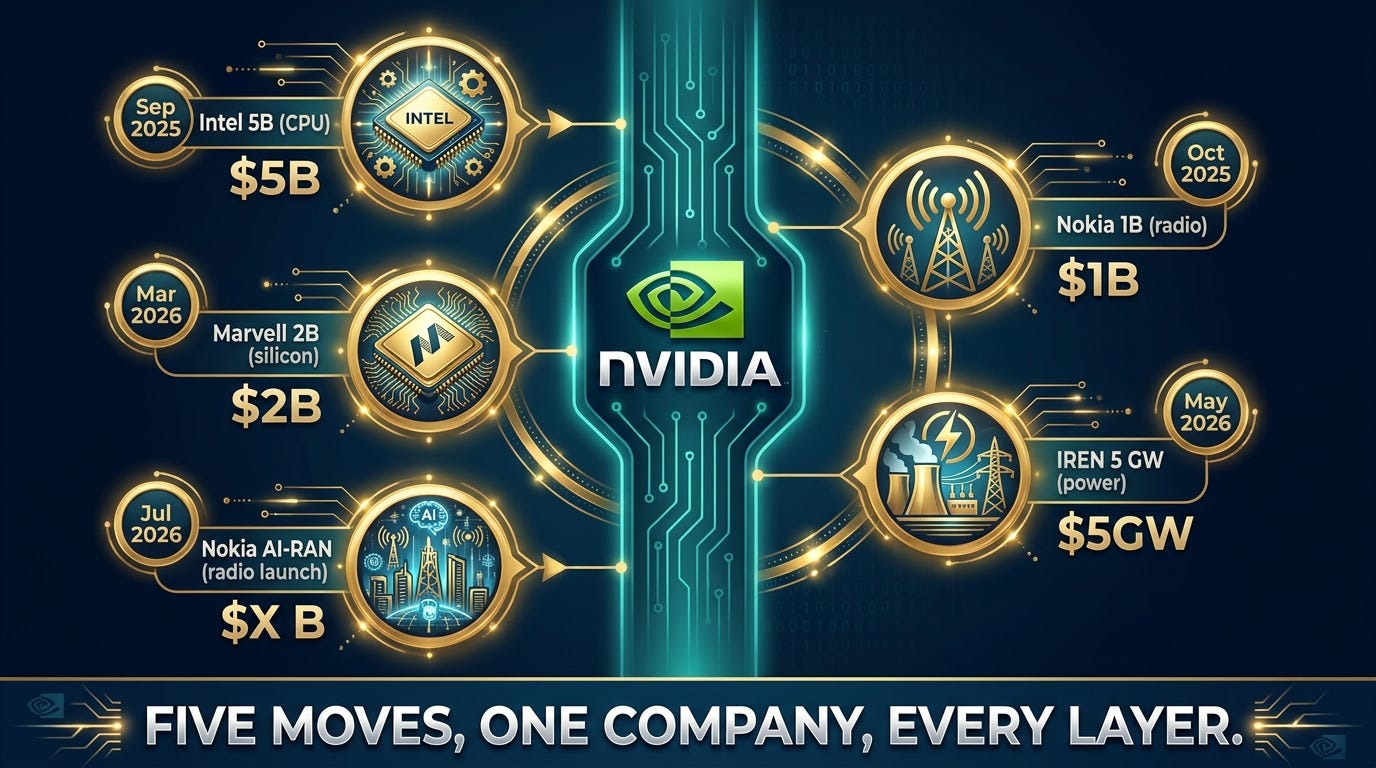
NVIDIA put $1B into Nokia last October, $5B into Intel in September, $2B into Marvell in March, and struck a 5 GW infrastructure partnership with IREN in May.
It already owns the networking layer through Mellanox and NVLink Fusion, and it now ships the data center itself as a pre-integrated rack. The radio launch is the newest rung on a ladder NVIDIA has been climbing for two years, converting the suppliers above and below its GPU into either channels or components and keeping the compute and the software for itself.
This is not a company selling chips. It is a company absorbing an industry, one vertical at a time.
🧭 The Thesis This Week
Consensus: The Nokia launch proves AI has arrived in the radio and will double spectral efficiency by the end of the decade.
The Vector position: The launch is not a RAN story; it is the latest step in NVIDIA’s absorption of every compute-adjacent vertical, converting intermediate suppliers into resellers or components while keeping the high-margin compute and software layers and outsourcing only land and power.
Endpoint: By the end of 2027, AI-RAN sorts into an NVIDIA-inside camp led by Nokia and a vendor-neutral, custom-silicon camp led by Ericsson, and NVIDIA’s telecom revenue stays immaterial against its data-center business, because the real prize is architectural control, not RAN sales.
Grade: Inside 90 days, watch whether a second Tier 1 carrier beyond SoftBank and SK Telecom commits to GPU-based AI-RAN, and whether Ericsson holds or breaks its no-NVIDIA silicon line.
📌 What Execs Should Do This Quarter
Map your NVIDIA exposure across the stack.
Most boards track GPU dependency in the data center only. The Nokia launch shows the same dependency migrating into the network, the CPU, and the interconnect. Dependency in one layer is a vendor relationship; dependency in three is a structural position that is slow and expensive to unwind. Inventory where a single vendor now sits in more than one layer you rely on.Treat reference architecture as a lock-in decision.
A pre-integrated rack or an AI-RAN node shortens time-to-market and quietly standardizes your future on one vendor’s roadmap. The question is not whether to use pre-integration; it is where the standardization it imposes is acceptable and where it forecloses options you will want later. Decide that deliberately, layer by layer.Ask what each supplier still owns.
A vendor that owns differentiated silicon keeps its negotiating leverage; one that does not becomes a channel. Ownership of silicon is the best single predictor of whether a supplier can hold its price and its independence across a full contract cycle. Nokia embraced NVIDIA; Ericsson refused, with its own silicon. Know which of your suppliers is which.Price the escape valve before you need it.
Merchant silicon from Marvell and a vendor-neutral path from Ericsson exist precisely so buyers keep an alternative. The premium to keep a second source funded is cheap insurance against a single vendor setting terms across your whole stack. Fund at least one contestable path, even at a small cost penalty.
The full mechanism, vendor map, scenario probabilities, and board-ready exposure matrix are in the paid extension below.
🎯 Upgrade to read the extension
This issue is written for the executive who has to decide how much of the AI stack to source from a single vendor. The paid extension gives you the four-move absorption mechanism, the vendor and investor landscape, the named counter-argument from Ericsson, Qualcomm, and Marvell, the Absorption Ladder framework, three probability-weighted scenarios, and a public-company snapshot. It maps where the pattern has already spread, where it stalls, and what has to happen in the next ninety days for the base case to hold. It is a permanent reference for the procurement and board conversations this launch will start.
